

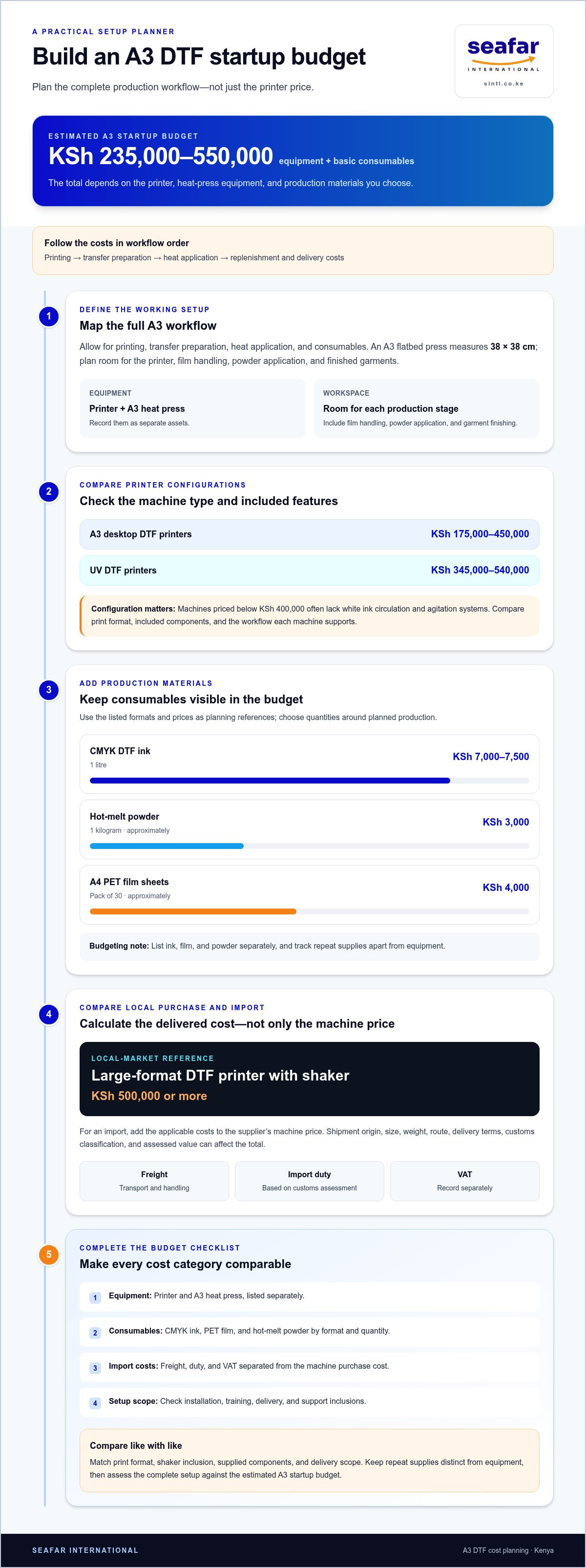
An A3 DTF startup in Kenya can require an estimated KSh 235,000-KSh 550,000 for equipment and basic consumables. The DTF printer price in Kenya is only one part of that budget; heat-press equipment and production materials also affect the amount you need to set aside.
It’s sensible to compare the full setup cost, not just the printer’s listed price. This guide breaks down the two key costs for an A3 startup and explains why prices vary with printer format, equipment configuration and the supplies needed to begin production. You’ll get a practical basis for planning a setup that fits your intended workflow and budget.
Key Takeaways
- Budget for the complete A3 production setup, not just the printer; the press and starter consumables also affect your launch costs.
- Compare printer types and configurations to understand why listed prices vary across Kenya.
- Assess local-supplier and import options by considering the full equipment setup and what is included in the purchase.
- Review the printer, heat press and other workflow equipment together to identify a setup suited to your production needs.
1. A3 DTF startup budget
Plan an A3 DTF startup as a complete workflow, not a printer purchase alone. The setup needs printing, transfer preparation, heat application, and consumables. An A3 flatbed press measures 38 × 38 cm, giving you a defined working area for matching equipment. Include space for the printer, film handling, powder application, and finished garments. This helps define the practical scope behind a DTF printer price in Kenya.
How much do DTF ink, film, and powder cost in Kenya? One litre of CMYK DTF ink is listed at KSh 7,000-KSh 7,500, while one kilogram of hot-melt powder is approximately KSh 3,000. A pack of 30 A4 PET film sheets is approximately KSh 4,000. Choose quantities and formats around planned production, then record replenishment separately from equipment. These inputs shape the operating budget alongside the DTF printer price in Kenya.
Set the initial budget in clear categories. Include the printer and press, starter consumables, installation needs, and workspace. Keep repeat supplies distinct from equipment so replenishment doesn’t disappear inside the startup figure. For example, CMYK ink and PET film support different production stages, so list them separately in your worksheet. Compare DTF printer prices in Kenya against the complete A3 workflow, rather than the machine alone.
What are the shipping, import duty, and VAT costs for importing a DTF printer to Kenya? These costs depend on the shipment’s origin, size, weight, customs classification, and assessed value. Freight covers transport and handling, while duty and VAT follow the customs assessment. Record each component separately to calculate the landed cost and assess the full DTF printer price in Kenya.
- Equipment: Record the printer and A3 heat press as separate assets.
- Consumables: List CMYK ink, PET film, and hot-melt powder by format and quantity.
- Import costs: Separate freight, duty, and VAT from the machine’s purchase cost.
2. DTF printer price ranges in Kenya
A3 desktop DTF printers in Kenya are listed at KSh 175,000-KSh 450,000. UV DTF printers sit in a separate range, at KSh 345,000-KSh 540,000. Compare each category against the transfer method and materials your business will process. Similar prices don’t necessarily mean similar printer configurations, so assess the working format and intended output alongside the listed amount.
Configuration matters. Machines priced below KSh 400,000 often lack white ink circulation and agitation systems. Assess those systems alongside print format, included components, and the workflow needed to prepare transfers. A machine price alone doesn’t show whether the configuration fits your production requirements. Compare quotations by matching the same equipment features, then account separately for the supporting equipment and consumables each setup needs.
How much does DTF printer maintenance and repair cost in Kenya? Replacing a clogged DTF printhead often costs more than KSh 30,000. Other repair costs depend on the fault, required parts, and service work, so identify the affected component before estimating a repair budget.
Is a DTF printer or a sublimation printer more cost-effective for a Kenyan printing business? DTF supports transfers across a wider range of fabrics, while sublimation is suited to compatible polyester materials. Compare the products you plan to print, material costs, and workflow requirements. The more cost-effective option depends on your production mix and the materials your customers request.
Where can I buy a DTF printer in Kenya? Printing equipment suppliers serve businesses nationally, with local supply and imports forming purchasing routes. Compare equipment configuration, delivery scope, and support options when assessing suppliers. You can also review Kenyan printing equipment options as part of your purchase research.
What warranty, installation, and after-sales support do Kenyan DTF printer sellers offer? Terms vary by machine and seller. Compare warranty coverage, installation, training, and repair support separately. Distinguish machine coverage from setup assistance, then consider how each affects commissioning and ongoing operation.
3. How much do DTF printers cost from Kenyan suppliers compared with imports?
Compare the delivered setup, not just the advertised machine price. In Kenya, large-format DTF printers with shakers are listed at KSh 500,000 or more. That figure gives a local-market reference for larger production equipment, while imported machines require a landed-cost calculation before comparing offers.
For an import, start with the supplier’s machine price and add shipping, import duty, and VAT where applicable. Freight and handling depend on shipment dimensions, weight, route, and delivery terms. Customs assessment and applicable charges also affect the total. A low advertised price may therefore be a poor guide to overall expenditure.
Compare both purchasing routes using the same checklist:
- Machine configuration: Match print format, shaker inclusion, and the components supplied.
- Delivered cost: Separate the purchase price from freight, handling, and import charges.
- Setup requirements: Account for installation, training, and production readiness.
- Support route: Consider how parts, maintenance, and technical assistance will be handled.
A Kenyan supplier can quote equipment in KSh and arrange a local purchase. An import may involve extra transport steps and charges before the machine reaches your workshop. Compare the full scope of each offer, including what comes with the printer and what you must arrange separately. An itemised quotation makes these differences easier to assess.
For example, compare a locally supplied large-format unit with shaker against an imported unit configured for the same production workflow. Check whether both offers include the same main components and delivery scope. Then calculate the import’s landed total using its shipment and customs details. The local listing of KSh 500,000 or more is a reference, not a like-for-like import quote.
Choose the route that suits your production plan and procurement capacity. If simpler delivery matters, a local purchase may be a better fit. If you can manage freight and import processing, compare overseas equipment by its landed cost. In either case, treat the DTF printer price in Kenya as one part of a broader equipment comparison, not the sole basis for your decision.
Shipping and handling depend on shipment dimensions, weight, route, and delivery terms. Add applicable import duty and VAT, based on the customs assessment, to the machine price to calculate the landed cost.
4. What is included in the price of a DTF printer in Kenya?
A DTF quotation may cover only the printer or a broader production package. Check the listed contents before comparing prices. The printer, printhead, software, inks, film, powder, and heat press each serve a different role and affect what else you need before production can begin.
Start with the machine configuration. Note the print format, printhead details, and any included ink delivery components. Then check whether the quote includes software, a computer, or setup support. A printer-only quote and a package with a heat press require different comparisons, even when they include the same printer category.
- Printer components: Note the machine configuration and printhead stated in the quotation.
- Production supplies: Separate ink, PET film, and hot-melt powder from durable equipment.
- Transfer equipment: Record whether a heat press appears as a separate item.
- Setup scope: Identify installation and training as distinct inclusions or services.
Consumables need clear quantities and formats. An A3 PET film pack differs from a smaller sheet pack, while CMYK ink and white ink perform separate print functions. Record each supply by type, quantity, and unit. This makes replenishment easier to estimate and prevents starter materials from being mistaken for ongoing supply.
Separate delivery and setup from the equipment price. A complete quotation should itemise the printer, accessories, consumables, installation, and training where applicable. If the heat press is quoted separately, include it in your planned workflow cost rather than assuming it comes with the printer. Use the same checklist to compare every offer.
Before choosing, match every listed item to a production task. Confirm which components arrive with the machine and which require separate purchasing. For help comparing DTF equipment configurations and setup needs, review printing equipment options and use the quotation scope to guide your comparison.
SEAFAR INTERNATIONAL: DTF 700 with I3200 printhead
SEAFAR INTERNATIONAL supplies the DTF 700 with I3200 printhead for businesses planning an in-house DTF workflow. Turn to this option when you’re comparing printer configurations and want to assess the press equipment needed alongside the printer. The Yinghe 38 × 38cm Flatbed Heat Press Machine | A3 Size can form part of an A3 setup, while a 2-foot Plotter serves a different equipment role.
Compare the printer and supporting equipment against your intended production tasks. The YINGHE 1.8M ECO-SOLVENT PRINTER · EPSON i3200 is another listed printer option, but it uses a different printing category. Keep that distinction clear when matching equipment to your output requirements.
Contact SEAFAR INTERNATIONAL to discuss the DTF 700 with I3200 printhead, or visit sintl.co.ke.
Plan the next step for your print setup
Turn your budget into a workflow plan before choosing equipment. Define the products you intend to print, the transfer format, and the production stages your workshop will handle. Then compare the printer, press, consumables, and setup support you need. This gives your DTF printer price in Kenya assessment a practical basis, rather than relying on the machine price alone.
SEAFAR INTERNATIONAL offers the DTF 700 with I3200 printhead and equipment for supporting print and branding workflows. If you’re moving from price research to configuration decisions, use your intended output and workspace requirements to frame the discussion. That keeps the next step focused on operational fit.
Contact SEAFAR INTERNATIONAL to discuss your DTF setup. Build your plan around the work you intend to produce, then move forward with a clearer equipment brief.
Frequently Asked Questions
How much does a DTF printer cost in Kenya?
Cost depends on the printer’s format, configuration, and included equipment. A desktop unit and a production-scale system suit different output volumes, so compare their working formats and workflow requirements before weighing prices. Also distinguish the printer from a heat press, consumables, installation, and training. These items can change the total investment needed for a working setup.
What are the prices of A3 and A1 DTF printers in Kenya?
A3 and A1 DTF printer costs depend on format, machine configuration, and package contents. Compare the usable print area with the designs and order sizes you expect to process. Then assess whether each quotation includes the same supporting equipment and setup components. A larger format can suit broader production needs, but the right choice depends on your intended output and available workshop space.
Which DTF printer brands and models are available in Kenya, and what do they cost?
Available options include the DTF 700 with I3200 printhead. Compare models by print format, included components, and the workflow they support, rather than relying on a model name alone. A DTF printer and a heat press are separate equipment categories. For example, the Yinghe 38 × 38cm Flatbed Heat Press Machine | A3 Size supports transfer application, not printing.
What is the total setup cost for a DTF printing business in Kenya?
The total setup cost depends on the production workflow you plan to run. Budget separately for the printer, transfer press, consumables, workspace preparation, and any installation or training. A business producing A3 transfers, for example, needs to account for both printing and heat application. Build your equipment list around the products you intend to make, then compare complete setup requirements.

