

A DTF printer for a print business is only one part of the production setup. It prints coloured designs and a white-ink foundation onto transfer film; a heat press then applies the design to fabric or another suitable surface. DTF can be used on cotton, polyester and blended fabrics, so planning needs to cover the whole workflow, not just the machine.
Choosing the printer is a major decision, but workspace, finishing equipment and routine white-ink care also shape production. Plan for enough room to print and press, a practical maintenance routine and support that helps operators get started.
This guide compares DTF with screen printing, DTG, sublimation and HTV, and explains what to consider when planning workspace, maintenance, equipment bundles and training. Use these points to assess whether DTF and a particular setup suit your print business in Kenya.
Key Takeaways
- Compare DTF with other decoration methods by fabric compatibility, transfer process and the type of work your shop handles.
- Plan the print, pressing and finishing workflow around your available workspace, ventilation and routine white-ink care.
- Assess the full equipment setup, including the heat press, consumables and operator training, rather than judging a printer on its own.
- Use installation and technical support requirements to evaluate whether a setup fits your production needs in Kenya.
2. DTF compared with screen printing, DTG, sublimation, and HTV
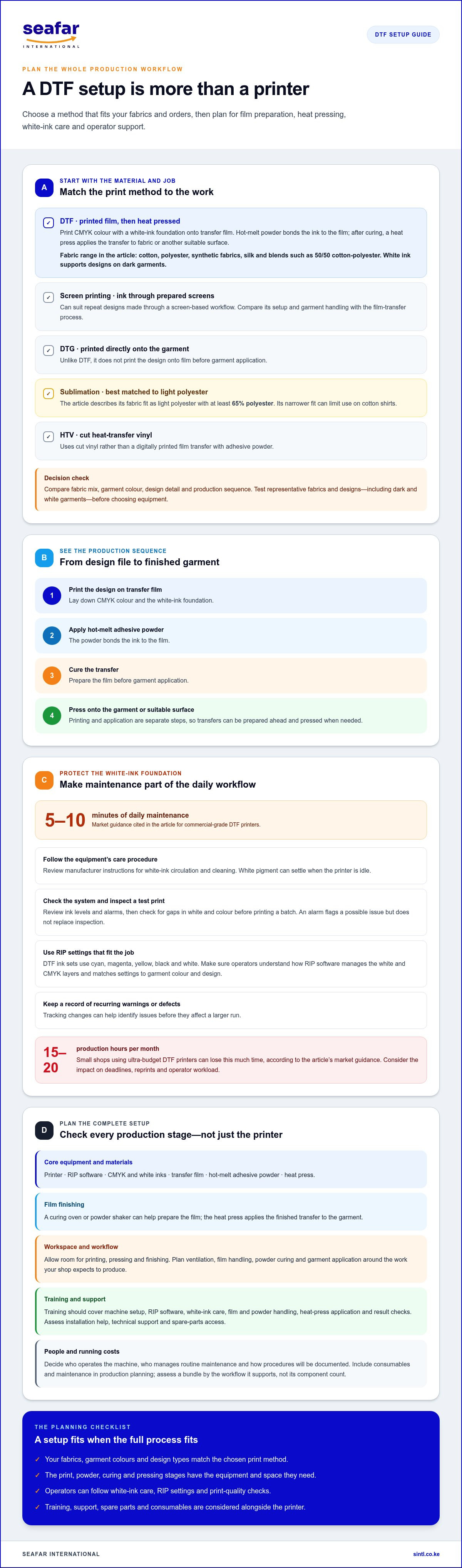
DTF printing creates the design on transfer film before it is applied to apparel. The printer lays down CMYK colour and a white-ink foundation, then hot-melt powder bonds the ink to the film. After curing, a heat press applies the design to a garment or other suitable surface. Because printing and garment application are separate steps, shops can prepare transfers in advance and press them when needed.
Fabric compatibility is a key distinction. DTF works on cotton, polyester, synthetic fabrics and silk, including cotton-polyester blends such as 50/50 fabric. White ink provides an underlayer for designs on dark garments, while coloured pigment supplies the image. Sublimation has a narrower fabric fit: it suits light polyester fabrics with at least 65% polyester. Match the method to the actual fabric mix and colour range in your orders.
Screen printing applies ink through prepared screens, rather than printing a design onto DTF film. It can suit repeat designs made through a screen-based workflow, while DTF provides a film-transfer option for custom designs and short runs. DTG prints directly onto a garment; DTF prints onto film first and then uses a heat press. Compare setup steps, garment handling and the equipment your shop can operate consistently.
Sublimation transfers dye into suitable polyester material, which can limit its use on cotton shirts. DTF offers a broader range of fabric options, while HTV uses cut heat-transfer vinyl instead of a digitally printed film transfer with adhesive powder. Assess each method against the substrate, design detail and production sequence. A shop handling cotton and mixed-fabric orders may prefer DTF’s material range; one focused on light polyester can consider sublimation. Test representative fabrics and designs, including dark and white garments, before choosing equipment.
3. White-ink maintenance and budget printer drawbacks
White ink needs careful management because its pigment can settle when the printer is idle. In DTF printing, white ink forms the foundation beneath CMYK colour, helping designs show on dark apparel. A blocked white-ink channel can compromise that foundation and interrupt production. Follow the equipment’s maintenance procedure, keep the ink system moving as designed and inspect output for missing areas before printing a batch.
Build maintenance into the operating routine. Commercial-grade DTF printers require 5 to 10 minutes of daily maintenance, according to the market guidance. Use that time to review the printer’s stated care steps, check ink levels and alarms, and inspect a test print. Keep a record of recurring warnings or output defects. This makes it easier to spot changes before they affect a larger run.
DTF ink sets use cyan, magenta, yellow, black and white. RIP software manages the white and CMYK layers, so make sure operators understand how it handles the underbase. An ink alarm can flag a level or system issue, but it does not replace routine inspection. Check the ink supply and printed result before continuing an order.
- Review the manufacturer’s white-ink circulation and cleaning instructions.
- Run a test print after maintenance, checking for gaps in white and colour.
- Use RIP software settings that match the garment colour and design.
Budget equipment deserves a workflow assessment, not just a purchase-price comparison. Small shops using ultra-budget DTF printers can lose 15 to 20 hours per month in production time, according to the market guidance. Consider how interruptions affect order deadlines, reprints and operator workload. Compare the maintenance routine, alarm handling and available training with the production demands of your shop.
Before committing, map ink care against your daily workflow and operator capability. Review DTF equipment and setup options alongside your maintenance requirements.
4. Printer bundles, training, and support
A DTF workflow requires more than a printer. Budget for RIP software, CMYK and white inks, transfer film, hot-melt adhesive powder and a heat press. A curing oven or powder shaker can help prepare the film, while the press applies the finished transfer to a garment.
In Kenya, businesses can source DTF printers, inks, films and powder from suppliers of DTF systems and consumables. Buying the printer and production inputs through one supplier can simplify compatibility planning and replenishment.
Assess a bundle by the complete workflow it supports, not by its number of components. Match the printer to expected orders, then account for film handling, powder curing and garment application. A shop producing custom shirts, for example, needs a way to prepare transfers and a suitable press to apply them. If a bundle omits a necessary stage, operators must source and assemble that part separately.
Training should cover machine setup, RIP software, white-ink care, film and powder handling, and heat-press application. Operators need clear procedures for preparing a design, producing a transfer, applying it to a garment and checking the result. Installation and operator training help establish a repeatable process. Support and spare-parts access also matter: downtime can disrupt orders, and unavailable parts can delay production.
Compare the support included with the tasks your team must handle after installation. Decide who will operate the machine, who will manage routine maintenance and how staff will follow documented procedures. Include consumables and maintenance in production planning. Profit depends on matching equipment and running costs to work you can sell, rather than adding components your workflow will not use.
Map the printer, heat press and finishing equipment into a single production plan. DTF business setup planning can help frame that equipment and training decision around your intended workflow.
4. How much does a DTF printer cost in Kenya?
There is no single useful price for a DTF setup in Kenya across every configuration. The total depends on printer capacity, print width, included equipment and the supplies needed to start production. Compare complete setups rather than printer prices alone.
Start by defining the work you plan to produce. A shop handling short custom runs has different equipment needs from one preparing repeat production batches. Match printer capacity to expected order volume, then account for the heat press, film, ink, powder and RIP software. Each item affects how the production line works and what the business needs to budget for.
Separate initial equipment costs from recurring consumables. Ink, transfer film and adhesive powder are used in production; maintenance and potential waste affect ongoing costs. Depending on how transfers are prepared, the setup may also need a curing oven or powder shaker. List these requirements against your planned workflow before comparing supplier quotations.
Use this sequence to build a realistic cost assessment:
- Define the garment types, design sizes and expected order mix.
- Choose printer capacity and print width for that workload.
- List the press, curing equipment, RIP software and opening supplies.
- Include installation, operator training, maintenance and production waste.
Compare quotations on the same basis. Check whether each covers the printer, essential finishing equipment, software, consumables, installation and training. A lower equipment-only price may exclude items needed to print and apply a transfer. For example, compare a printer-only configuration with a complete printer-and-press workflow, including the film and powder needed for production.
For a business in Kenya, build your budget around the actual configuration and supply route, including local stock or import options. Estimate the cost per job from consumables, labour, maintenance and waste, then compare it with the revenue the order can generate. This links equipment selection to operating viability without relying on a generic international price range.
Explore DTF setup options to map equipment and workflow needs before planning your investment.
SEAFAR INTERNATIONAL: DTF 700 with I3200 printhead
SEAFAR INTERNATIONAL supplies the DTF 700 with I3200 printhead for print businesses assessing an in-house DTF workflow. Pair the printer decision with finishing requirements: the Yinghe 38 × 38cm Flatbed Heat Press Machine | A3 Size is a relevant heat-press option for applying transfers.
Turn to SEAFAR INTERNATIONAL when comparing equipment with your planned production process or setting up a print business. Installation, training and business setup support the transition from choosing a machine to preparing operators and workflows. Consider the printer, press, workspace and maintenance together, rather than treating the printer as a standalone purchase.
For other print requirements, the available equipment also includes a 2-foot Plotter, YINGHE 1.8M ECO-SOLVENT PRINTER · EPSON i3200, and Large format printer YH-1800A. These serve different production methods, so base selection on the work your business intends to produce.
Contact SEAFAR INTERNATIONAL to discuss equipment and setup for your print business.
Turn your production plan into a practical setup
Before selecting a DTF printer for a print business, define the work you want to take on and the production sequence your team can manage. Map a typical order from artwork preparation through transfer finishing and garment application. This makes equipment selection a workflow decision, not just a comparison of specifications.
Use that plan to identify operational priorities: the fabrics and designs you intend to handle, how operators will maintain the equipment and what support they need during setup. Keep the initial workflow clear and repeatable. A defined process helps your team assess capacity, operator readiness and future expansion without adding equipment that does not serve current work.
SEAFAR INTERNATIONAL can discuss equipment and setup options around your intended print workflow. Bring your production requirements into the conversation and discuss your equipment options.
Build a workable production plan first, then expand as your needs change.
Frequently Asked Questions
What is DTF printing?
DTF, or direct-to-film printing, decorates garments by creating a design on transfer film for later application. A print shop can prepare artwork separately from the garment, which is useful when orders include different sizes or designs. For example, prepare a batch of transfers first, then apply them as the garments are ready.
Why is DTF printing a useful option for small businesses?
DTF can suit small businesses handling changing artwork, personalised orders or short production runs. A shop can prepare designs as transfers instead of setting up a screen for every graphic. This can simplify orders with different names or designs. Operators still need to manage the equipment, consumables and finishing as part of the production plan.
What is a DTF printer, and how does it work?
A DTF printer outputs a design onto transfer film. RIP software processes the artwork for printing, including its white and colour layers. After printing, the film is coated with adhesive powder and cured, then applied to the garment with a heat press. The printer is one stage in the production sequence, not the entire setup.
Which DTF printer models are best for starting a print business?
There’s no single best model for every new shop. Match printer capacity and print width to expected orders, available workspace and the finishing workflow. A DTF printer for a print business should also fit the operator’s ability to manage software and routine care. SEAFAR INTERNATIONAL offers the DTF 700 with I3200 printhead; assess its fit against your intended work.
What are the running costs and profit margins for DTF printing in Kenya?
Running costs depend on consumables and production choices, including ink, film, adhesive powder, labour, maintenance and rejected transfers. To assess your margin, track these inputs for a representative order and compare the total with the price charged for the finished work. Include pressing and reprints in the calculation. Order size and design coverage affect material use.
How does DTF compare with DTG, sublimation and screen printing?
DTF prints onto film before the design is applied to a garment; DTG prints directly onto the garment. Sublimation suits light polyester, while screen printing uses prepared screens to apply ink. Choose the method that fits the material, design and job type. Varied designs on cotton shirts, for example, may suit a film-transfer workflow, while light polyester work may suit sublimation.

